They Put Us in the Wrong Box
Race, Class and the Politics of a Frustrated Imagination

There is a story some people tell themselves about Black people in Britain. It is not a complicated story. It requires no elaboration, no evidence, no argument. It runs entirely on assumption, held in the gut, the glance, the architectural geometry of expectation. The story goes: Black people ,those whose families came through Windrush, or more recently through the long corridors of post-colonial migration from West Africa, East Africa, the Caribbean belong at the bottom of the class order. Not because anyone says so out loud anymore. But in the breath before the sentence. In the blank space where a different possibility should have been allowed to grow.
Guy Standing’s class framework has given fresh vocabulary to that old assumption. And the frustration now feeding Reform UK the rage of the so-called left behind is, in significant part, the rage of people discovering that we are not where the story said we would be.
Standing’s Map of a New World

To understand the argument, we need to understand the terrain. Standing, Professor of Development Studies at SOAS and co-founder of the Basic Income Earth Network, proposed in his landmark 2011 work *The Precariat: The New Dangerous Class that the traditional three-tier model of British class working, middle, upper had been replaced by something more fractured and more dangerous.
His seven-tier model runs from a tiny plutocratic elite-at the apex stateless in practice, owning wealth beyond national accountability through salaries (stable professional employees with pensions, benefits, and occupational identity), the proficians (highly skilled freelancers and consultants, well-paid but insecure, burning bright and burning out), the proletariat (the dwindling traditional working class of the industrial era), down to the precariat itself Standing’s defining new class those living in chronic insecurity, with stagnant wages, no occupational benefits, no welfare entitlement worth the name, and no narrative of progression. Below them: the unemployed and the lumpen-precariat, the fully marginalised.
Standing’s central argument is stark. As he wrote: Every progressive political movement has been built on the anger, needs and aspirations of the emerging major class. Today that class is the precariat. It is growing. It is politically volatile. And, crucially for our argument, it is being deliberately misread along racial lines.
The Assumption and the Evidence
The assumption, held widely and not only by those outside London who have arrived in Britain more recently — is that Black people occupy the proletariat and the precariat: Groups Four and Five. That is where the story places us.
The statistics, read selectively, have long provided cover for this assumption. The Runnymede Trust’s landmark Colour of Money report found that Black African and Bangladeshi households hold only **10p for every £1 of average White British household wealth. Black Caribbean households hold around 20p in every £1. The average White British household holds £332,300 in wealth; the average Black African household holds £32,400 Black Africans are 75% more likely, and Bangladeshi households 63% more likely, to experience housing deprivation than White British households (De Noronha, 2024).
These are real numbers. They reflect real structural injury the compound interest of colonial extraction, discriminatory lending, the *No Blacks, No Irish, No Dogs era of housing exclusion, and decades of wage suppression. The racial wealth divide is not imagined. In June 2025, the LSE and Runnymede Trust published a joint report Why the UK Racial Wealth Divide Matters: A Call for Action confirming that these gaps have widened, not narrowed, over the past decade.
The story, then, has a statistical foundation. But it tells only part of a much more complex truth. And the part it omits is the part that is breaking certain people’s minds.
The Part the Story Leaves Out
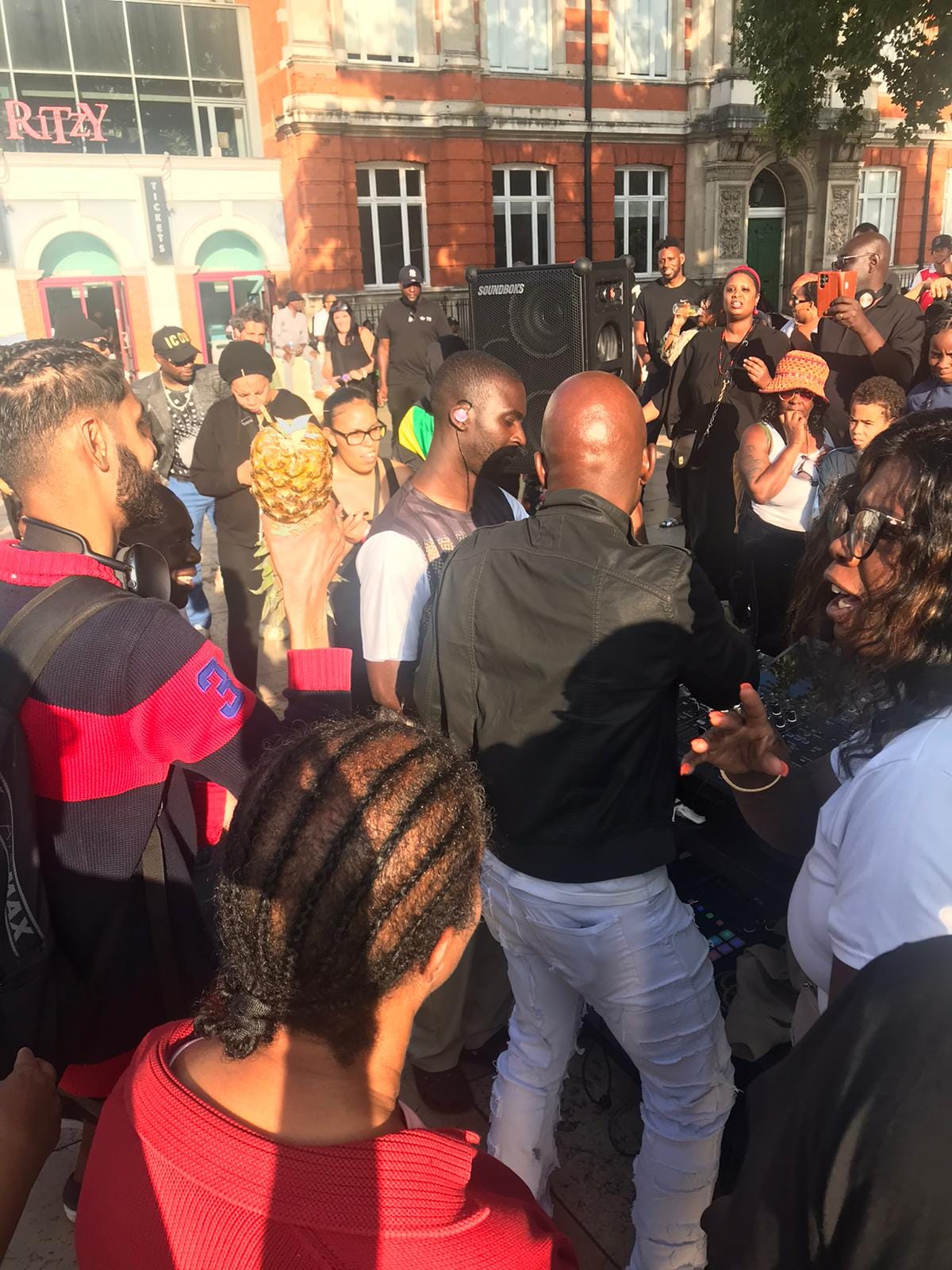
There is now a substantial, documented, visible Black British salariat. This is not aspiration. This is structural fact.
The NHS the largest employer of Black, Asian and minority ethnic staff in Europe employed 28.6% of its total workforce from BME backgrounds as of March 2024, up from 26.4% the previous year. Black doctors now represent a higher share of the NHS medical workforce than of the wider working-age population, according to the Institute for Fiscal Studies (Stockton and Warner, 2024). By 2025,
12.7% of very senior NHS managers were from BME backgrounds an 85% increase since 2018. The average basic pay of a full-time equivalent doctor in England reached £87,701 in June 2025.
This is salariat Group Two employment. It is salaried, pensioned, professionally credentialled, institutionally embedded. And it is increasingly Black.
Beyond the NHS, the Goldsmith’s research into the Black British middle class documents a deliberate, associational strategy: Black-only professional networks, mentoring pipelines, cultural institutions functioning as what the researchers call “counterpublics” spaces where racial identity, community responsibility, and economic advancement are developed outside the white gaze and the white gatekeeping structure.
It is not frictionless. The 2024 NHS Workforce Race Equality Standard data showed that at 80% of NHS trusts, white applicants were significantly more likely to be appointed from shortlisting than their global majority counterparts. In 99% of trusts, global majority staff reported greater experiences of discrimination than white colleagues. The salariat is real; so is the ceiling. But the ceiling is not a glass floor. Black professionals are in the building.
Stuart Hall, the Jamaican-born intellectual whose work still defines the field, argued that race is deployed as a prism through which people are called upon to live through, to understand, and then to deal with crisis conditions.What we are witnessing now is exactly that: a crisis in the class order being refracted through the prism of race, with Black and brown presence in the salariat re-cast as the cause of a dispossession that was actually produced by neoliberal economic policy across four decades.
The Alchemy of the Precariat
Here is the detail that truly unsettles the story. Those Black people who are in the precariat or have passed through it have not accepted Standing’s prognosis of fragmentation, isolation, and political vulnerability. They have done something Standing’s model struggles to account for: they have built parallel economies that allow them to live across class categories simultaneously.
The Susu. The Pardner. The Stokvel. The Ayuto. These are not cultural relics. They are sophisticated, field-tested financial architectures that predate by centuries the credit systems white Britain built and then selectively extended or withheld. As documented by the African Diaspora Network (2024) and National Stokvel Association of South Africa (NASASA), these rotating savings and credit associations have historically provided the lump sums needed for house deposits, school fees, business seed capital, and the legal costs of protection from a system designed to exclude.
The mechanism is simple; the discipline it requires is profound. A group of trusted individuals contributes a fixed sum at regular intervals. Each rotation, one member receives the accumulated total the “hand.” The system requires no credit score. No bank manager. No mortgage broker. No discriminatory algorithm. It runs on something more durable than institutional trust: community trust.
This is how Black households in the precariat have been able to live, in material terms, as if they occupy the salariat. Not through fraud. Not through luck. But through the collective application of a generational intelligence that knows what the formal system will and will not offer and builds accordingly.
Paul Gilroy, writing about Black Atlantic cultural production, described how working-class” meant something entirely different in Black London communities not simply an economic position, but a site of radical cultural and economic production.* This is that production, made financial.

Kehinde Andrews, the UK’s first Black Studies professor, has been more blunt. In *The New Age of Empire* (2021), Andrews argues that the structures of capitalism have never been designed to include Black people as equal participants and therefore that Black economic survival has always required operating both *within* and *around* those structures simultaneously. The community savings strategy is not a workaround. It is a tradition. It is, as Andrews frames it, a form of economic resistance that predates the current crisis by generations.
The result Black households in the precariat presenting the outward material markers of the salariat — is not a deception. It is a survival strategy built over centuries, by people who were never given the option of queuing politely for institutional access.
Brown Britain in Groups One, Two and Three
Alongside this, and equally disturbing to those who believed the class order was racially fixed, is the question of Britain’s South Asian communities particularly British Indians who now occupy Groups One, Two and Three in significant numbers, including in the major cities where this visibility is most acute.
The data here is now historic. The January 2026 LSE report confirmed that Indian-origin households have become the wealthiest ethnic group in the UK, with median household wealth reaching £206,000 in 2021/23 having risen from £93,000 in 2012/14, outpacing all other ethnic demographics. The White British median, for comparison, rose from £125,000 to £177,000 over the same period. Indian households now have the highest homeownership rate of any ethnic group in England 70%, compared to 68% for White British and 23% for Black African.
The wealth was built through exactly the mechanism Standing’s model describes for the salariat: stable professional employment, asset accumulation, pension entitlement, educational capital compounding across generations. The proportion of Indian and Chinese workers in professional and managerial occupations now matches or exceeds that of White British workers, per ONS data.
This is not anecdote. It is a measurable, documented restructuring of the ethnic geography of British class. And it sits in direct, unignorable contradiction to the story.
Reform as the Death Cry of the Racial Guarantee
Reform UK is not, at its core, an immigration party. It is a grief party. It is the political expression of those who feel that a guarantee has been broken.


The guarantee was never written down. No one put it in a contract. But it was felt in working-class communities that, for all their economic precarity, understood themselves to hold a racial position. Not wealthy. Not powerful. But positioned. Above someone. That was the floor.
The numbers tell us who is actually turning to Reform. Research published in *The Political Quarterly* (2025) found that Reform voters in 2024 were *more* educated, slightly more likely to own their own home, and had slightly higher incomes than the stereotypical “left behind” voter. Their political activation is not purely poverty-driven. It is identity-driven. It is the activation of people who have watched the class order fail to hold its racial shape.
A 2025 YouGov tracker found that 56% of working-class people believe none of the main parties represent their priorities up from 42% in 2019. A Public First poll found that more than half of this disaffected group now intends to vote Reform. Immigration is the stated issue; the underlying wound is the failure of the floor.
In working-class constituencies, as the Political Quarterly research documents, Reform’s vote now exceeds what UKIP ever obtained. The geography of that vote tracks the geography of deindustrialised Britain places where the salariat once included a significant white working-class layer, with unionised manufacturing jobs, pensions, and occupational pride. Austerity stripped that layer bare. What Standing identifies as the precariat is now the numerical reality for millions of white working-class people who were told, for generations, that however bad it got, they would not be at the bottom.
And now they look around, and there is a Black woman in the salariat, a Pakistani-heritage doctor in the detached house on the good street, a Nigerian entrepreneur with more cultural capital and more community financial resilience than they can access through any institutional channel and the story has broken.
Kehinde Andrews warns: Whiteness is a set of ideas produced by the racist political and economic system, and as long as that system remains intact, it will continue to reproduce delusions that prevent all of us from seeing the brutal reality of the social world we inhabit. What he is describing is precisely this: the delusion that race guarantees position, colliding with the reality that capitalism has always been indifferent to whiteness at the bottom a detail temporarily obscured by empire, by industrial wages, by union protection, by the specific historical conditions of post-war Britain that no longer obtain.
Reform is the political form taken by that collision. It is not a solution to precarity. It is a demand to restore the floor by removing those who have, against the grain of expectation, refused to stay beneath it.
The Longer View
What this moment requires is not the management of white frustration. It is an honest reckoning with what the class system in Britain was always also about.
Stuart Hall wrote that race is “one of the most important keys”to understanding British and global Western capitalist culture not a footnote, not a subcategory, but a constitutive structure. The class system was racialised from the beginning. The post-war welfare state that created the salariat was built partly on the backs of Windrush labour the nurses, the bus drivers, the factory workers who were then excluded from many of the benefits that same state provided. The wealth gap that the Runnymede Trust documents is not an accident of different cultures or different values. It is the accumulated, compounded, statistically measurable consequence of that exclusion.
The community strategies that now allow Black households to live across class categories the Susu, the Pardner, the professional network, the supplementary school are not cheating. They are the long, patient, generational work of people who understood that the formal system would not come for them, and built accordingly.
That work is now visible. And the question Britain faces through the rise of Reform, through the hardening of immigration policy, through Starmer’s talk of an *“island of strangers”* as political cover is whether the country will respond to that visibility with curiosity and reckoning, or with the old reflex.
The data suggests the reflex is winning, for now.
But the data also shows in the NHS workforce figures, in the LSE wealth survey, in the rotating savings circles, in the Black middle-class counterpublics documented by Goldsmiths that the communities it is directed at have been navigating exactly this reflex for a very long time.
They are not in the wrong box.
They never were.
Key Data at a Glance
- Black African household median wealth: £32,400 vs. White British £332,300 (Runnymede / LSE, 2025)
- Indian household median wealth overtook White British in 2021/23: £206,000 vs. £177,000(LSE, 2026)
- Indian homeownership: 70% | Black African homeownership: 23% (JRF / Robinson et al, 2024)
- NHS BME workforce: 28.6%of all staff; BME very senior managers up 85% since 2018 (NHS WRES, 2024)
- Black NHS doctors: higher share of medical workforce than Black share of working-age population (IFS, 2024)
- Nearly 40% of Black African graduates are in non-graduate jobs almost double the White British rate (Runnymede)
- Reform vote in working-class areas now exceeds UKIP’s peak (Political Quarterly, 2025)
- 56% of working-class people say no party represents them; over half back Reform (YouGov / Public First, 2025)
Voices Informing This Essay
- Guy Standing — *The Precariat: The New Dangerous Class* (Bloomsbury, 2011)
- Stuart Hall— *Selected Writings on Race and Difference* (ed. Gilroy & Gilmore, Duke UP, 2021)
- Paul Gilroy — There Ain’t No Black in the Union Jack (1987); *The Black Atlantic (1993)
- Kehinde Andrews— The New Age of Empire(2021); *The Psychosis of Whiteness (2023)
- Runnymede Trust— The Colour of Money (2020); Why the UK Racial Wealth Divide Matters* (2025)
- LSE International Inequalities Institute / Eleni Karagiannaki — racial wealth gap analysis (2025/26)
- NHS Workforce Race Equality Standard— annual data reports (2024/25)
- The Political Quarterly — Heath, Prosser et al., *The 2024 General Election and the Rise of Reform UK* (2025)
Joseph Rowntree Foundation— Ethnicity and Homeownership (2025)
Institute for Fiscal Studies— Stockton & Warner, Ethnic Diversity of NHS Doctors (2024)
Ophelia Osagiede Bellio is a published poet, playwright, and healing therapist. Her debut collection, Breath and Other Poems, is published by Olympia Publishers. She writes at opheliawritess.substack.com.